| Summary | Introduction/ | Evidence | Evidence | Newest |
| Motivations | as of 2007 | as of 2010 | Evidence |
 HOME PARTICIPATE
| Codes about codes |
| Creation of the world |
| Creation of light |
| Creation of humanity |
| The Patriarchs |
| Temple destruction |
| Titus and exile |
| Temple rebuilt |
| The Twin Towers |
| Messiah |
| Conclusion |
Codes about the Messiah
We have found a number of intriguing codes about the Messiah. He is described in Jewish tradition as the son of David, referring to King David. King David was the son of Jesse, and the Messiah is also described as son of Jesse, for example in the Friday evening prayer, "Lechah Dodi", welcoming the Sabbath.
Note - there is a very significant January 2009 update below, under Fig 9.
The following code, found by Dr. Leib Schwartzman and Professor Rips, started with the simple question "who is Messiah?" in blue. The extension, in red, was the first additional ELS to be noticed. With this extension, the entire vertical string now reads: "Your request: who is Messiah?" The next surprise was the promise of an answer, in green. The third unexpected addition was the string "son of Jesse". The fourth surprise was the extension to "son of Jesse" (see the phrase highlighted in yellow). The fifth surprise (August 2007) is the occurrence of "son of David" as a very compact 1D code (highlighted in 2 shades of purple). Such a compact 1D configuration (with skip 1 or -1 for son of) occurs only 3 or 4 times in the whole Torah.
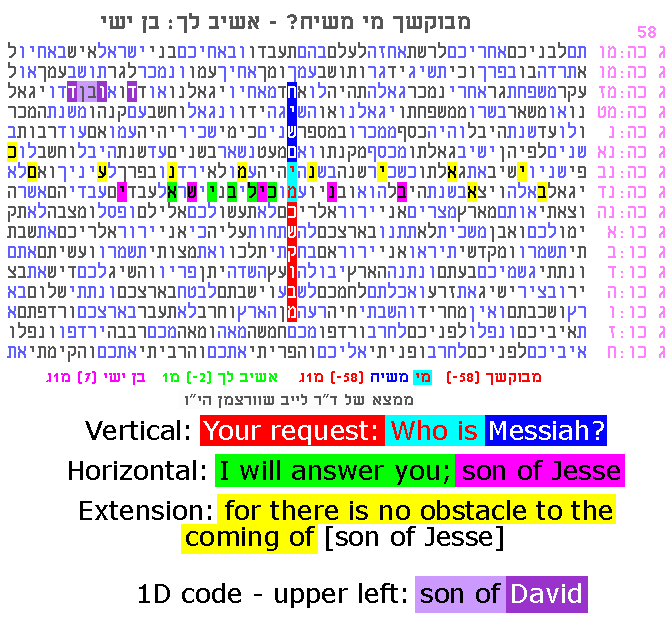
Fig. 1
Yet another suprise is that this phrase crosses the word "Messiah" in the bin Laden sentence:
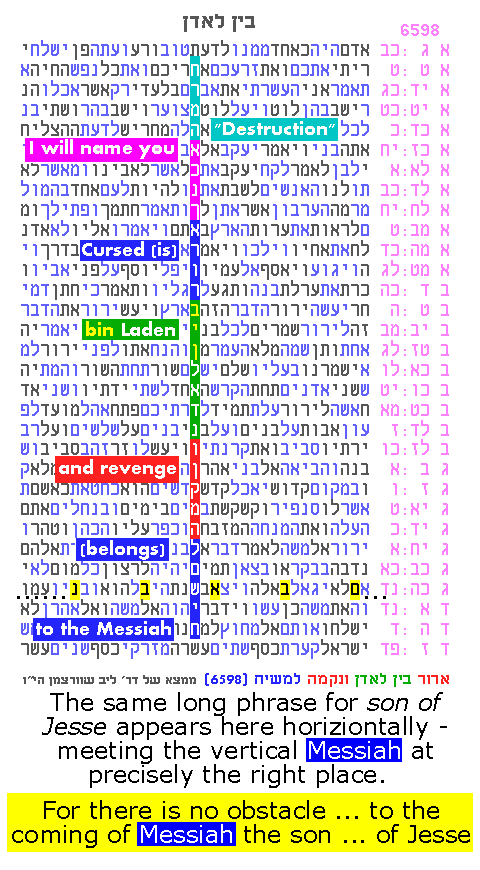
Fig. 2
As a simple but telling additional test of the basic key words, we checked for "son of Jesse" with Messiah", to see if they appear elsewhere together. In fact, they appear in parallel, with a very small skip of 26 (in red and blue respectively):
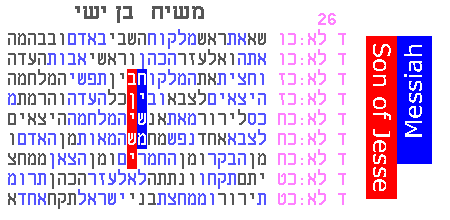
Fig. 3
Next, we have a phrase for "son of David", with skip 183 (first minimum for son of David in Exodus):
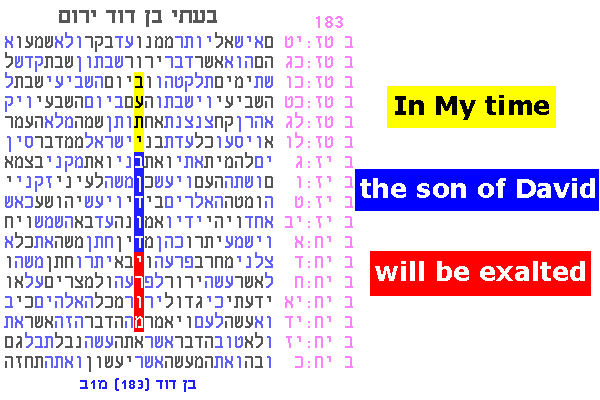
Fig. 4
The references to timing and to being exalted are in a style similar to what we find in Biblical passages from the Prophets. For statistical significance, see the January 2009 update under Fig 10 below.
Again, we checked the most basic key words, this time "son of David" and "the Messiah". Again, we found them in a significant configuration, this time back-to-back and collinear (son of David, in yellow and red, runs up the page, while the Messiah, in blue, runs down the page):
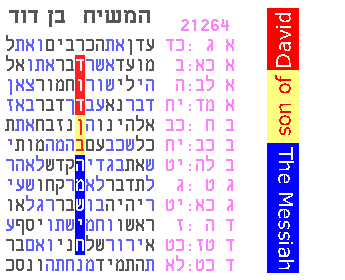
Fig. 5
Next, we have 3 cases of codes combining David, Jesse and/or Messiah. First, house of David (an expression referring to his dynasty), is in blue, with the extension "and Jesse" in red:
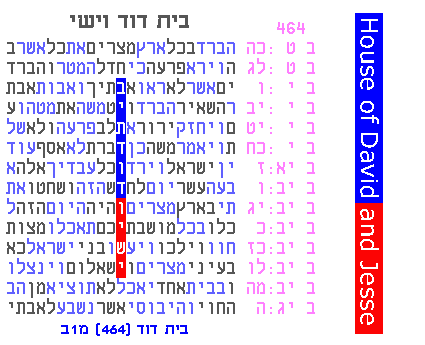
Fig. 6
Next, son of Jesse is in blue, in the same column and sharing one letter, with son of David in red:
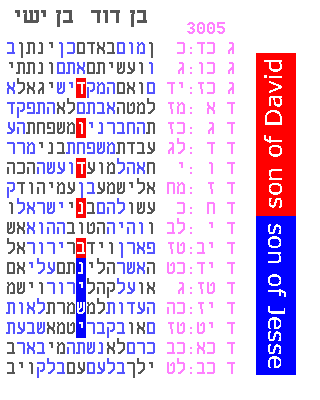
Fig. 7
One more combination table is similar to the above in its collinear portion (son of Jesse [blue] back to back and sharing one letter with son of David [red]). In addition this table contains a 1D code at the bottom, with Messiah in red and son of Jesse in green.
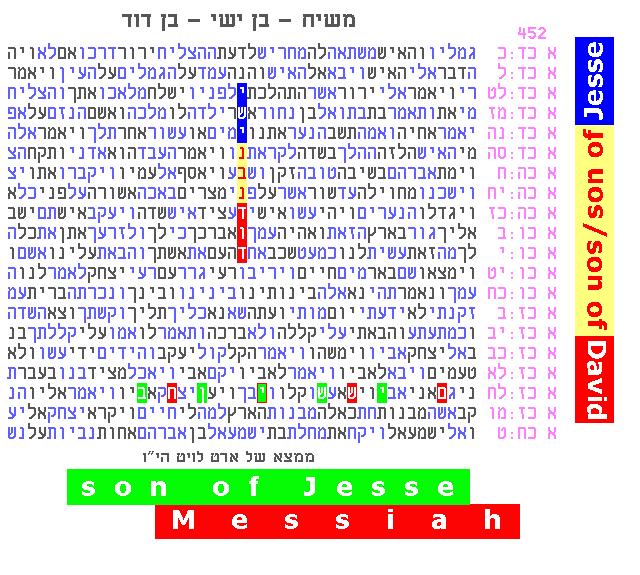
Fig. 8
Finally, here is a long phrase surrounding Messiah.
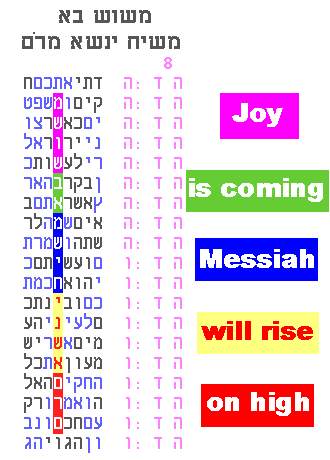
Fig. 9
Update - January 2009 - Significance of the 3 long phrases on this page (Figs 4, 9, and the following Fig 10, a redrawing of only the long phrase from Fig 1):
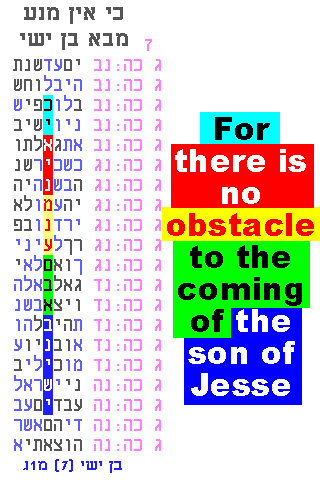
Fig. 10
First, an observation; Notice the many repeated themes in such a small sample [very small, because these are the first/only long phrases found (i.e. using the lowest skip for which an intelligible phrase was found) for each key word denoting the Messiah (i.e. son of David, son of Jesse, and Messiah)]. We see the idea of "no obstacle to the coming" repeated in the phrase "joy is coming". And we see the three phrases "will be exalted", "will rise", and "on high" also repeating a theme.
Second, we can do the full component analysis for these 3 phrases (feel free to skip the details and simply note the boldfaced remarks). This analysis was done formally for the bin Laden phrase. We follow the same method again, using the data from our former survey of over 20 Hebrew speakers. Here are the 4 components of the 3 phrases, and their relevance ratios, computed as in the bin Laden case. We treat the 4 components as a single set for the topic of Messiah. This assumes that our three starting strings, son of Jesse, son of David and Messiah, are at the top of the list of words that best reflect the concept of the Messiah as described in the Hebrew Bible:
1) joy is coming has score 120/12500 = 9.6 e-3
2) will rise on high has score 15.5/12500 = 1.24 e-3
3) no obstacle to the coming has score 380.5/12500 = 3.04 e-2
4) in My time will be exalted has score 22/12500 = 1.76 e-3
(The "gatekeeper" correction is already part of each numerator above.)
Combining these with the Fisher statistic gives an initial probability of 1.17 e-6, which is then adjusted by a factor of 8 (to reflect the "ease of formation" combined with the number of ELSs with lower skips than those chosen). This yields a final probability of about 1 chance in 100,000 that these 3 long phrases are as relevant as we observe.
Interpretations: once again, we do not attempt to read meanings into what we are seeing. The ideas of "joy" and "no obstacles" are certainly hopeful, but the Talmud tells us that we have free will, and there is no guarantee for the timing of any particular outcome. We must simply do our best to fulfill what the Torah prescribes, starting with the Ten Commandments.